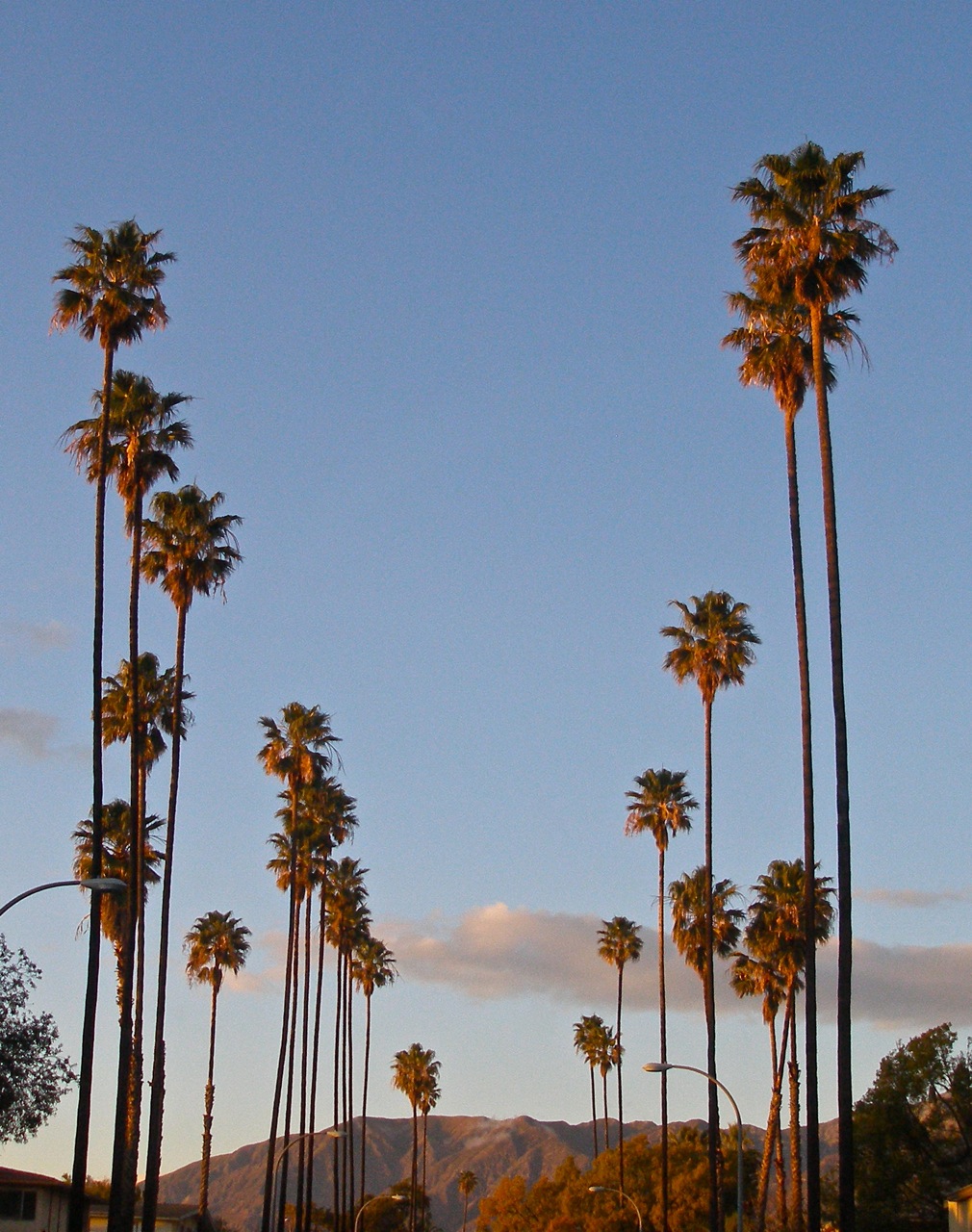
I kept getting up from my dinner last night to photograph the sunset. I finally had to stop because I was hungry. My kitchen window at my Mt. Wilson hideout looks out over Pasadena and Altadena, to the west of where I sit.
I'm fortunate to have a weekend getaway in a cabin at Mt. Wilson Observatory, high above Pasadena in the San Gabriel Mountains. Mt. Wilson was founded in 1904 by George Ellery Hale. Einstein visited here. Here, at the 100-inch telescope, Edwin Hubble discovered and proved the expansion of the universe.
While I thought of the great scientists, the moon rose almost full to shine over the places they'd walked. The valley to the west and south twinkled. The Observatory still houses scientists and experiments, but larger telescopes in Chile and Hawaii are used for the Hubble-type discoveries these days. We have too much light pollution here now.
Night critters began to make their moves. The windows and doors have screens and a breeze flows through, so I've got air conditioning without bugs. Depending on what time of year you come up, you might want a bug net that goes over your hat. I'm told the nets are $4 at Big 5. I'll have to get one for next time. The (seasonal) gnats adore me and escort my face wherever I go. Except in my cabin. They haven't figured that out yet. It's a good strategy for staying inside and writing.
It's been a long time since I've watched the sun rise. Today is the first time I've ever watched it from up on the mountain. After I had my coffee I took a walk to get some exercise, snoop and take pictures. I will never run out of Mt. Wilson pictures to post.
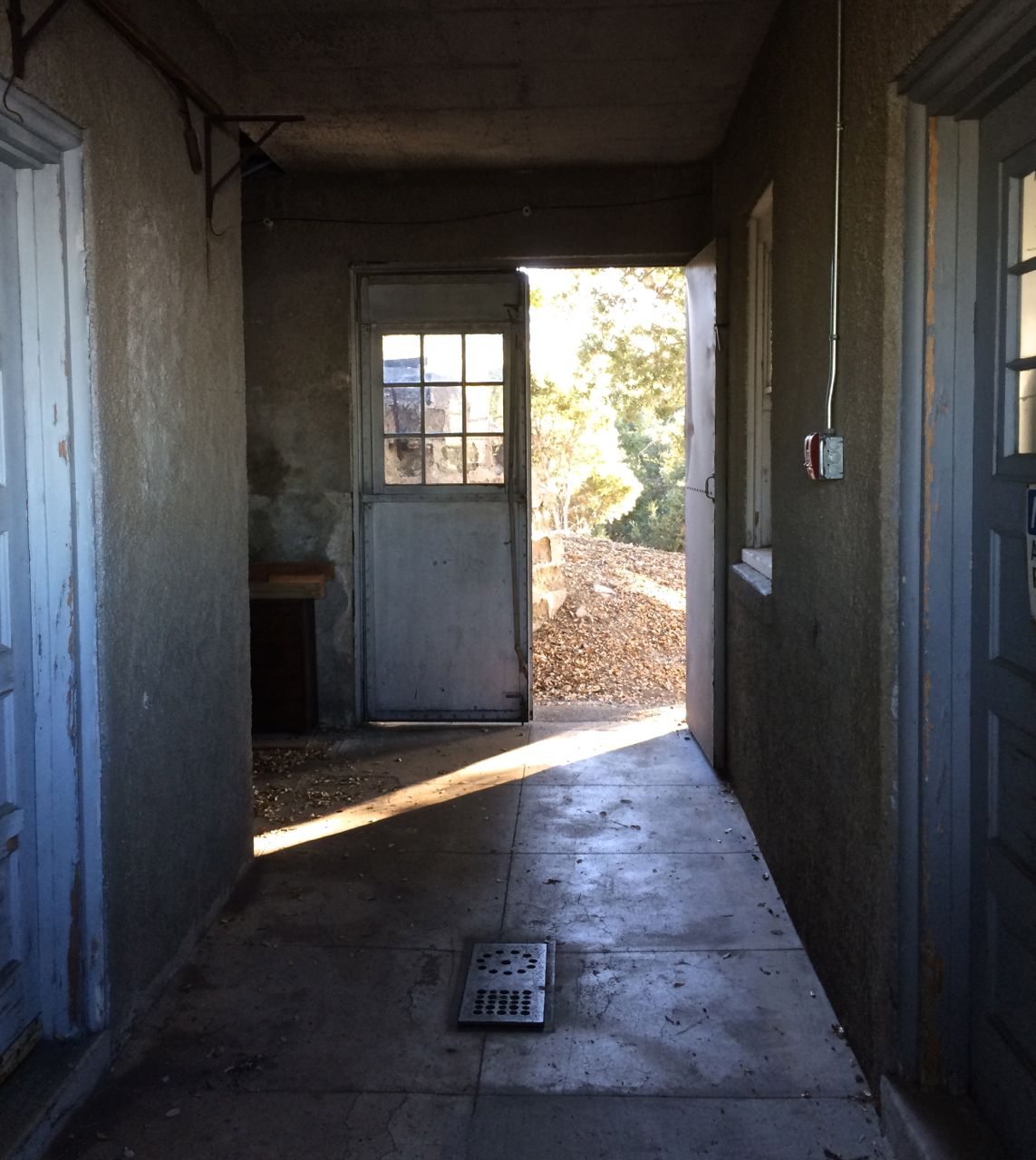
This walkway between an office and the machine room had some lovely light, so I photographed it without noticing the thing on the floor. Probably a drain. But of course I must go back and make sure.
This building houses the Snow Solar Telescope, which was the first telescope on the mountain. Hale brought it here in 1904. I've never seen it. Maybe that's because it's in use even now.
People live here. At least four cabins are occupied, as far as I know. I haven't snooped everywhere, but I can ask. I'm fascinated by the idea and I feel privileged and grateful to be here for my writing weekend.
I keep saying "my." I'm feeling ownership. I was sitting here typing when a family of tourists walked by, having ignored the "do not enter" signs and marched on into the private areas. I was immediately outraged. Then I understood their curiosity. I'm pretty sure they heeded the "DANGER: DO NOT ENTER!" signs beyond the monastery because if they hadn't they might not have come back.
I want you to have a proprietary feeling about the Mt. Wilson, too. As the Observatory ages it becomes more of a museum, and this amazing place will need you more and more, to be its protectors, visitors and benefactors.
Come on up. It's open 10am-5pm, 7 days a week, as long as the roads are open. And it'll take you longer to drive from Pasadena to Santa Monica than it'll take you to get here from just about anywhere.
I promised pictures of the monastery. I haven't forgotten.
Showing posts with label San Gabriel Mountains. Show all posts
Saturday, September 26, 2015
Friday, March 13, 2015
Southwest Museum (Birthday Month Adventure #2)
The Southwest Museum is another place I've always wanted to visit but hadn't until Birthday Adventure Month. Maybe always wanting to go but never having gone is one of my unconscious criteria for an adventure.
I'm determined to have at least one adventure per week this month. It's not easy to schedule adventures! I'm so focused on working. But adventures fuel me and I've never regretted one, even the ones that don't turn out like I expect them to. Especially those.
The Southwest Museum, the oldest museum in Los Angeles, looms over the Pasadena freeway, all southwestern/Spanishy in the sun. Damage from the 1994 Northridge Earthquake was so extensive the building had to be closed, and eventually it was acquired by the Autry Museum along with its extensive collections of Native American pottery, baskets and weavings, not just from the southwest but from all over the country. There's a complicated history to this. This link was sent to me by a friend.
There's only one exhibit room open right now, and a few pieces displayed in a downstairs hallway. I found the straw sandal to be the most affecting. It's a fine exhibit, but don't go expecting a full day. The Museum is open Saturdays only. It's free, there's plenty of parking, and you'll see glorious Native American pottery, some pieces as much as 500 years old, some from the late 20th century.
The website is a bit misleading. I clicked on a link for the cafe but it turns out that's at the Autry. We were so hungry that we skipped out without seeing the tunnel, approached from the disabled parking lot on a lower level of the hill. The elevator's not working right now, so if you are wheelchair-bound you're restricted to the upper level. But that's where the pottery is so you'll see most of the good stuff (but not the sandal).
An adventure doesn't always turn out like you expect it to. That's adventure by definition, in a way.
You might want to enlarge this one to appreciate the snow-covered San Gabriel peaks in the distance. This is a view I hadn't seen before, easily gained by stepping to the edge of the parking lot at the Southwest Museum.
Note: Pasadena Adjacent was across the Arroyo from us at about the time of these photos. She was painting watercolor #19 in a series.
I'm determined to have at least one adventure per week this month. It's not easy to schedule adventures! I'm so focused on working. But adventures fuel me and I've never regretted one, even the ones that don't turn out like I expect them to. Especially those.
The Southwest Museum, the oldest museum in Los Angeles, looms over the Pasadena freeway, all southwestern/Spanishy in the sun. Damage from the 1994 Northridge Earthquake was so extensive the building had to be closed, and eventually it was acquired by the Autry Museum along with its extensive collections of Native American pottery, baskets and weavings, not just from the southwest but from all over the country. There's a complicated history to this. This link was sent to me by a friend.
There's only one exhibit room open right now, and a few pieces displayed in a downstairs hallway. I found the straw sandal to be the most affecting. It's a fine exhibit, but don't go expecting a full day. The Museum is open Saturdays only. It's free, there's plenty of parking, and you'll see glorious Native American pottery, some pieces as much as 500 years old, some from the late 20th century.
The website is a bit misleading. I clicked on a link for the cafe but it turns out that's at the Autry. We were so hungry that we skipped out without seeing the tunnel, approached from the disabled parking lot on a lower level of the hill. The elevator's not working right now, so if you are wheelchair-bound you're restricted to the upper level. But that's where the pottery is so you'll see most of the good stuff (but not the sandal).
An adventure doesn't always turn out like you expect it to. That's adventure by definition, in a way.
You might want to enlarge this one to appreciate the snow-covered San Gabriel peaks in the distance. This is a view I hadn't seen before, easily gained by stepping to the edge of the parking lot at the Southwest Museum.
Note: Pasadena Adjacent was across the Arroyo from us at about the time of these photos. She was painting watercolor #19 in a series.
Saturday, December 6, 2014
Wednesday, January 2, 2013
Bad Photos of the B2 Bomber
Here's what my iPhone's zoom lens made of the B2 when it was circling with its buddy over the mountains. (Yes, there were 2 B2's.)
It headed our way. I waited.
It was a lot faster than these pictures.
Couldn't hear it 'til it was almost on me.
I knew it was going to fly over the eucalyptus tree but I didn't have time to move to a better spot.
Then it was over me.
Then it was gone.
A lot of people waited on the bridge. In other words, it's likely that much better photos are available.
Monday, December 31, 2012
Rarin' to Go
I went out to get a picture of snow on the mountains. I was too late for the best of the stuff, and I got rain instead. It was cold out, though, so maybe that rain will be snow tomorrow. Always look on the bright side!
Down here in the flatlands there'll be sun, a parade, and a football game to kick off the new year. From my house I'll be able to see the Goodyear blimp floating over the Rose Bowl Stadium. (We saw a low-flying plane pulling a banner ad above the Arroyo Seco yesterday--some folks start early.)
2012 was a good year, yet I'm ready for 2013. Rarin' to go, actually, with my big fat plans. What are yours?
Down here in the flatlands there'll be sun, a parade, and a football game to kick off the new year. From my house I'll be able to see the Goodyear blimp floating over the Rose Bowl Stadium. (We saw a low-flying plane pulling a banner ad above the Arroyo Seco yesterday--some folks start early.)
2012 was a good year, yet I'm ready for 2013. Rarin' to go, actually, with my big fat plans. What are yours?
Tuesday, November 20, 2012
Weather
Heading north on Los Robles. Saw this. Felt lucky.
Does the weather affect your mood? I like a rainy day because I like to stay indoors with the heater on. I like a hot day because I like going without a sweater or even sleeves. I liked yesterday because it was cool without being cold; we'd had rain on Sunday and yesterday the world smelled good.
Saturday, February 4, 2012
Big Rock Candy
Toward the end of the day when it's nearly dusk here in the flatlands, the mountains north of Pasadena get a pinky-orange glow from sun still warming their folded slopes. It only lasts a few minutes (more than five, fewer than ten) so you have to pay attention.
I grew up in Illinois. It's flat there. Your eyes can go for miles without running into so much as a hill. Living here is a constant marvel--mountains! ocean! desert! And every time I look north I feel blessed, especially when the mountains are pink.
I'll tell you this, too: visits to Illinois, which don't happen often enough, bring just as much wonderment. When nothing obstructs your vision, it's amazing how much you can see.
I grew up in Illinois. It's flat there. Your eyes can go for miles without running into so much as a hill. Living here is a constant marvel--mountains! ocean! desert! And every time I look north I feel blessed, especially when the mountains are pink.
I'll tell you this, too: visits to Illinois, which don't happen often enough, bring just as much wonderment. When nothing obstructs your vision, it's amazing how much you can see.
Monday, August 1, 2011
Theme Day: Postcard-Worthy
You may be aware that the first of the month is Theme Day around the City Daily Photo world. Today's theme is "postcard-worthy." I think this eastward view of the San Gabriel Mountains from the lookout at Mount Wilson lives up to the theme.
If you've stopped in for your Monday Zen, never fear: we'll have one of our rare Zen Tuesdays tomorrow.
City Daily Photo is now 1408 blogs strong; the newest is Guatemala Daily Photo.
Wish you were here!
Click here to see other post cards from City Daily Photo bloggers around the world.
If you've stopped in for your Monday Zen, never fear: we'll have one of our rare Zen Tuesdays tomorrow.
City Daily Photo is now 1408 blogs strong; the newest is Guatemala Daily Photo.
Wish you were here!
Click here to see other post cards from City Daily Photo bloggers around the world.
Wednesday, July 27, 2011
Guest Author: Steve Scauzillo
Today's guest author is many things:
He's a journalist (Opinion Page Editor and columnist for the San Gabriel Valley Tribune, Pasadena Star-News and Whittier Daily News),
an educator (adjunct professor at Cal State Fullerton and Azusa Pacific University)
and a blogger (at Temple City Daily Photo).
He's also the 2011 recipient of the Leopold Award for Distinguished Editorial Writing.
Please welcome guest author Steve Scauzillo.
Rip Van Winkle, I’m not.
Though I like to fancy myself as someone who lives a wanderlust life, loafing around, meandering the mountain trails, stumbling on something new that catches my imagination.
Then, wrapping my camera eye around it so I can take that moment home with me like I used to do the lightning bugs from grandfather’s back yard on Long Island, though just for a few moments. There’s only so many mayonnaise jars a kid can hold.
In the Washington Irving story, Rip wandered the “Kaatskil Mountains” in New York until one day, the sweet mountain air made him so tired he fell asleep and did not awake until 20 years had passed. You can read the story for the ending. But I’m more interested in applying Irving’s lessons to me, and to you and our local mountains, the San Gabriel Mountains. It’s true, I enjoy a hike into the back country, or even the lower canyons. These forays chill me to the bone every time. On my blog, which starts where I live in Temple City, just a few miles south and east of Pasadena, I’ve posted about the places I’ll go ….usually my favorite mountain haunts. They are timeless respites from a chaotic world. But do they change over time? If I fell asleep under an oak in Marshall Canyon and woke up 20 years later, would I recognize the place?
I hope so.
I want to tell you about a place where I had a Rip Van Winkle moment. It’s called Crystal Lake. I last stepped foot there around 1991, when I was a young reporter working on a story about habitat restoration. I’ll always remember the nudge in my rib from the ranger’s bony finger telling me to watch out! I was about to put my hand on the cleft of a rock that was home to a curled up rattlesnake.
Crystal Lake is the only natural lake in the San Gabriels. It is oblong, surrounded by pines, and filled with fresh water. It had suffered drainage problems and in 2002-03, was filling up with ash from the nasty Curve and Bridge fires. That’s when it was closed to the public. Nine years later -- about half the length of a Van Winkle nap -- Highway 39 had reopened and the place was accessible. Had it changed in those 9 years?
Since 39 reopened this past March, the lake is accessible. To get there, take the 210 Freeway east, exit at Azusa Avenue and go north. This becomes Highway 39 or San Gabriel Canyon Road. Once you leave the last house in your rearview mirror, you enter some of the best canyons, riparian and later, pine forests in the world. And you don’t need a four-wheel drive car or chains. You may need chains in winter, so check with Caltrans first. Crystal Lake is 23 miles up the road, about 35 minutes from Azusa. You have to take the right turn-off before the 39 closure. The campground has been restored but is not yet operational.
The lake store is a story in itself. It’s owned and operated by Adam Samrah, who himself survived the Curve Fire by ducking into a low spot in the canyon and waiting for the conflagration to end. He vowed he would never leave the mountain, the place God spared his life. And he’s kept that promise. His store, the Crystal Lake Snack Bar is always open. He makes a mean chili.
If you go, don’t fall asleep up there. Well, OK, go ahead, it’s a perfect place for a nap. Just wake up sooner than 20 years later. But if you don’t, answer that question for me: Does it still look the same as it did 20 years earlier?
I hope so.
He's a journalist (Opinion Page Editor and columnist for the San Gabriel Valley Tribune, Pasadena Star-News and Whittier Daily News),
an educator (adjunct professor at Cal State Fullerton and Azusa Pacific University)
and a blogger (at Temple City Daily Photo).
He's also the 2011 recipient of the Leopold Award for Distinguished Editorial Writing.
Please welcome guest author Steve Scauzillo.
photo by Steve Scauzillo
Rip Van Winkle, I’m not.
Though I like to fancy myself as someone who lives a wanderlust life, loafing around, meandering the mountain trails, stumbling on something new that catches my imagination.
Then, wrapping my camera eye around it so I can take that moment home with me like I used to do the lightning bugs from grandfather’s back yard on Long Island, though just for a few moments. There’s only so many mayonnaise jars a kid can hold.
In the Washington Irving story, Rip wandered the “Kaatskil Mountains” in New York until one day, the sweet mountain air made him so tired he fell asleep and did not awake until 20 years had passed. You can read the story for the ending. But I’m more interested in applying Irving’s lessons to me, and to you and our local mountains, the San Gabriel Mountains. It’s true, I enjoy a hike into the back country, or even the lower canyons. These forays chill me to the bone every time. On my blog, which starts where I live in Temple City, just a few miles south and east of Pasadena, I’ve posted about the places I’ll go ….usually my favorite mountain haunts. They are timeless respites from a chaotic world. But do they change over time? If I fell asleep under an oak in Marshall Canyon and woke up 20 years later, would I recognize the place?
I hope so.
I want to tell you about a place where I had a Rip Van Winkle moment. It’s called Crystal Lake. I last stepped foot there around 1991, when I was a young reporter working on a story about habitat restoration. I’ll always remember the nudge in my rib from the ranger’s bony finger telling me to watch out! I was about to put my hand on the cleft of a rock that was home to a curled up rattlesnake.
Crystal Lake is the only natural lake in the San Gabriels. It is oblong, surrounded by pines, and filled with fresh water. It had suffered drainage problems and in 2002-03, was filling up with ash from the nasty Curve and Bridge fires. That’s when it was closed to the public. Nine years later -- about half the length of a Van Winkle nap -- Highway 39 had reopened and the place was accessible. Had it changed in those 9 years?
Since 39 reopened this past March, the lake is accessible. To get there, take the 210 Freeway east, exit at Azusa Avenue and go north. This becomes Highway 39 or San Gabriel Canyon Road. Once you leave the last house in your rearview mirror, you enter some of the best canyons, riparian and later, pine forests in the world. And you don’t need a four-wheel drive car or chains. You may need chains in winter, so check with Caltrans first. Crystal Lake is 23 miles up the road, about 35 minutes from Azusa. You have to take the right turn-off before the 39 closure. The campground has been restored but is not yet operational.
The lake store is a story in itself. It’s owned and operated by Adam Samrah, who himself survived the Curve Fire by ducking into a low spot in the canyon and waiting for the conflagration to end. He vowed he would never leave the mountain, the place God spared his life. And he’s kept that promise. His store, the Crystal Lake Snack Bar is always open. He makes a mean chili.
If you go, don’t fall asleep up there. Well, OK, go ahead, it’s a perfect place for a nap. Just wake up sooner than 20 years later. But if you don’t, answer that question for me: Does it still look the same as it did 20 years earlier?
I hope so.
photo by Steve Scauzillo
Thursday, December 31, 2009
Last Day, December 2009
On the last day of September I began this monthly theme: a photo of the same spot from the same angle. The idea is to view it at different seasons and watch it change over time.I've taken lots of pictures from this spot overlooking Johnson Field at Hahamongna Watershed Park. I chose this for one today because of the blue tint of the sky. I probably just hadn't white-balanced the camera, but I like the photo. It's end-of-yearly.
I could say many things about 2009, but I'll just say I've learned a lot and I'm glad it's over. I hope 2010 will be better for everyone. I wish you a joyous, healthy and prosperous new year.
To view the progression of the Last Day posts so far, click on the "Last Day Project" label below.
Thursday, October 22, 2009
Debris at the PWP Corral
In yesterday's comments the Altadena Hiker reminded us of the high waters behind the Devil's Gate Dam after a storm in spring of 2005. Greg Sweet wrote of the debris that builds up behind our local dams after big storms. That gave me the idea to post these pictures from spring of 2008 to show what Pasadena Water and Power does with storm debris behind Devil's Gate Dam.In the first two photos you can see JPL in the background. I didn't know what the line of connected logs was for at first.
But as the water recedes it becomes clear that the logs are in place to corral the debris that has gathered in the flood.
A lot of the debris is twigs and logs. But if you enlarge this photo you can also see plastic bags, styrofoam cups, a flashlight and a lot of unidentifiable stuff. If the water gets high enough, plastic bags and all sorts of weird junk hangs in the trees.
Sprocket and Boz find it absolutely delightful.I'd say the PWP does a fine job. But I have no idea where they put it all.

Thursday, October 15, 2009
Blog Action Day 2009
NASA's Jet Propulsion Lab hunkers down in the foothills of the San Gabriel Mountains. Enlarge the photo (or, as the Altadena Hiker says, "enbiggen" it) and you can see patchy scrub growing on the low hill behind the campus. The higher mountains beyond are barren. Every bit of vegetation that once grew on them burned in the Station Fire, which began on August 26th. Amazingly, the Station Fire continues to burn in small "nuisance smokes" today. The fire's been at 98% containment for a couple of weeks now.These empty, gray mountains go on for miles in either direction. As you drive through the towns below them it shocks you how far the fire went. And you see what the firefighters had to do: they beat the flames back and protected towns and structures. Beyond that, they had no choice but to let the fire go. 250 square miles of it. They saved the people. They couldn't save the forest.
In time, the forest will renew itself.
What if there had been no water available to fight that fire?
As of last count, 9975 blogs in 151 countries (and counting) are participating in today's Blog Action Day, expecting to reach over 13 million readers in a global discussion of climate change.
At the Copenhagen Climate Summit in December it will finally be time for America to step up. From Here to a Global Climate Treaty, a recent blog post at Avaaz.org, gives an idea of where the United States stands. There's a link to the Senate Finance Committee so you can see just which individuals it comes down to, besides you and me. We are a top emitter of greenhouse gases. We can urge our senators to help us take responsibility for our emissions. We can do something.
I think we can all agree climate change is happening. I'll leave it to the scientists to figure out how and why. Other crucial issues exist, but if there's not enough food because the earth can no longer grow it--if there's not enough water left on the planet to drink, let alone protect us from the inevitable fires brought on by global drought--then nothing else matters, does it?
Friday, September 4, 2009
Stress
The Station Fire has seriously stressed me out. The smoky air, the online discussions about bad (or nonexistent) news coverage, the talk of costs in money, not to mention lives. And now that we know it was arson my mind is completely blown.It's all relative. I live in Pasadena. My home has not, at any point, been threatened by the fire. Yet I'm stressed to the point of near-illness because of the effects this thing has on my community. My stress is nothing compared to that of the people who live up the hill in Altadena, or over the hill in Acton, or across the valley in Sierra Madre and Monrovia--the people whose bags are still packed in case they have to evacuate.
And the animals. It's too horrible to contemplate.
Then I think of the people who did have to evacuate. That's stress. But those who lost their homes are going through worse. Real people. I don't know them but I can put myself in their place, or lack of a place. It's devastating.
Real lives have been lost, too. Two lives, two firefighters. My heart goes out to their families. I'm so glad I married a guy who works at his computer. Having him here, now, is a great stress-reducer.
We talked about the firefighters last night. I imagine you have to love fire to be a firefighter. You have to love the challenge, the teamwork, the danger, the heat. The kudos, too, when you get them. You have to be able to deal with some major stress on that job, I would think. Maybe you even have to relish that stress.
We can never give them kudos enough, but we can try.
Saturday, February 28, 2009
Geology Lesson #2
February has been too much fun. Let's get serious and learn something here on the old blog. (Not that learning can't be fun.) Since we have a resident geologist at Pasadena Daily Photo, let's take time out for a geology lesson. After all, there's geology all over Pasadena.Here's our geologist, Becca, posing like a product model with a sedimentary deposit we found in the Hahamongna watershed basin. Becca adores sedimentary deposits. She explained it to me while I was taking the picture, but I didn't remember a word of it. So she sent me this email:
"In our last lesson we learned about graded bedding, in which the particle size decreases as one moves up a particular layer or bed. In contrast, this sedimentary deposit is a disorganized mix of pebbles and cobbles. A geologist would characterize this kind of rock unit - one in which a variety of particles are observed - as 'poorly sorted.' Upon closer inspection the geologist would also note that these are the same rock types that make up the San Gabriel Mountains, located several miles north of the Hahamongna watershed."
Then she throws a pop quiz into her email:
"How do you think these rocks were moved all the way from the San Gabriels to this basin?"
Becca gives three choices for an answer: wind, water or glaciers. I say it's water. Hahamongna's a watershed basin after all. I don't know when the glaciers were here last and I'm no geologist, but I'm pretty sure wind doesn't move rocks.
"Another observation about this deposit," Becca says in her email, "is that it's been heavily weathered. Weathering is the process by which rocks are broken down mechanically (size and shape changes) and chemically (the removal of minerals and addition of new minerals). Notice all the plants growing in the rock unit. This is an example of a physical weathering process called root wedging, during which roots force their way into the rock/deposit, breaking the rock into smaller pieces."
We also noticed some of the rocks had a rust-like coating. Becca says oxidation occurs when iron-rich minerals are exposed to oxygen, creating the reddish-brown stain. Aha! Like rust. Oxidation is a chemical weathering process, like she described. So this sedimentary deposit is going through both chemical and mechanical weathering.And, Becca says, the end product of weathering is the development of soil. I love that. It's so logical.
I hope I was right about the rocks being moved by water. I was applying logic, after all. It's less logical for them to have come down from the mountains by glacier, don't you think? And by wind? There's no logic in that whatsoever. Whimsy, maybe, but really it's just plain dangerous.
Subscribe to:
Posts (Atom)