Showing posts with label Edwin Hubble. Show all posts

Monday, September 28, 2015

Mt. Wilson Observatory Hideout IV: Farewell for Now

Update 10/2/15: I heard from Ken Evans, Mt. Wilson volunteer (thank you, Ken!). He's always got great info:
"Hi Petrea -  I was looking at your web page and saw your photo of the big bucket outside the Monastery kitchen at Mt. Wilson.  It was used to haul concrete up to the second floor of the Monastery during construction. I have seen photos on the Huntington Library digital images page that show the Monastery under construction. It shows a wood tower with pulleys and cable system to haul the bucket up. The power for the lift was a Model T Ford truck with ballast on the back to give traction.  The truck would drive forward and the bucket would go up. I think the concrete was then poured into wheel barrows and moved where needed."

Thanks, Ken!

Original post:

Last night's blood moon brought crowds to the Mt. Wilson Observatory. The parking lot is always open and it's a good spot for viewing the night skies. The Observatory itself closes to the public at 5pm but last night the staff left the gate open and people wandered, enjoying the grounds. Despite all the light from the city below it's still very dark up here, and fun to snoop. Everyone had a good time even though throughout most of the evening the moon demurely hid its heavenly body behind a tantalizing veil of clouds.

One does not get a good photo of a moon, even a giant blood moon, with an iPhone. You will find all the gorgeous shots you could possibly want elsewhere on the web. So for my last post from the mountain, I thought I'd show you things you won't find elsewhere. Above, that's a giant old bucket thing (technical term) behind the Monastery kitchen. Something from an old well? Chili cooker? The rim of the bucket came up to my waist.

Here's a view from a second floor window in the Monastery. I don't know what it is. You tell me. I like it in black and white. (Ken says these are "...old fashioned heat vents. Some times used on water heaters, or stove flues. I would have to look in the building to see if they are still in use. My guess is no.")

A better view of that drain we saw the other day.

Science moves on, always looking for the newest discovery. That's what science must do. Funding follows the biggest telescope, the latest thing. For the first half of the 20th century and beyond, Mt. Wilson Observatory was the cutting edge of astronomical research, but larger telescopes are now the norm. Important work is still done here (the Solar Telescopes, the CHARA Array, etc.), but the Observatory is in transition. What will it become? A museum of astronomical history? An Observatory? An educational facility? All three? What do you envision?

I'm not sure what's in Mt. Wilson's future, but I know what's in its past: major scientific discoveries that changed the world's understanding of itself and its place in the cosmos. Like Hubble's glass plate proving the expansion of the universe (a discovery he made here, using the 100-inch Hooker Telescope), it's impossible to place a monetary value on that.

I have been more than fortunate to experience this magical place in a private way. There's a lot here to do, see and think about. My endless thanks to those who made it possible.

Come visit, then let's talk some more.

Saturday, September 26, 2015

Mt. Wilson Observatory Hideout II

I kept getting up from my dinner last night to photograph the sunset. I finally had to stop because I was hungry. My kitchen window at my Mt. Wilson hideout looks out over Pasadena and Altadena, to the west of where I sit.

I'm fortunate to have a weekend getaway in a cabin at Mt. Wilson Observatory, high above Pasadena in the San Gabriel Mountains. Mt. Wilson was founded in 1904 by George Ellery Hale. Einstein visited here. Here, at the 100-inch telescope, Edwin Hubble discovered and proved the expansion of the universe.

While I thought of the great scientists, the moon rose almost full to shine over the places they'd walked. The valley to the west and south twinkled. The Observatory still houses scientists and experiments, but larger telescopes in Chile and Hawaii are used for the Hubble-type discoveries these days. We have too much light pollution here now.

Night critters began to make their moves. The windows and doors have screens and a breeze flows through, so I've got air conditioning without bugs. Depending on what time of year you come up, you might want a bug net that goes over your hat. I'm told the nets are $4 at Big 5. I'll have to get one for next time. The (seasonal) gnats adore me and escort my face wherever I go. Except in my cabin. They haven't figured that out yet. It's a good strategy for staying inside and writing.

It's been a long time since I've watched the sun rise. Today is the first time I've ever watched it from up on the mountain. After I had my coffee I took a walk to get some exercise, snoop and take pictures. I will never run out of Mt. Wilson pictures to post.

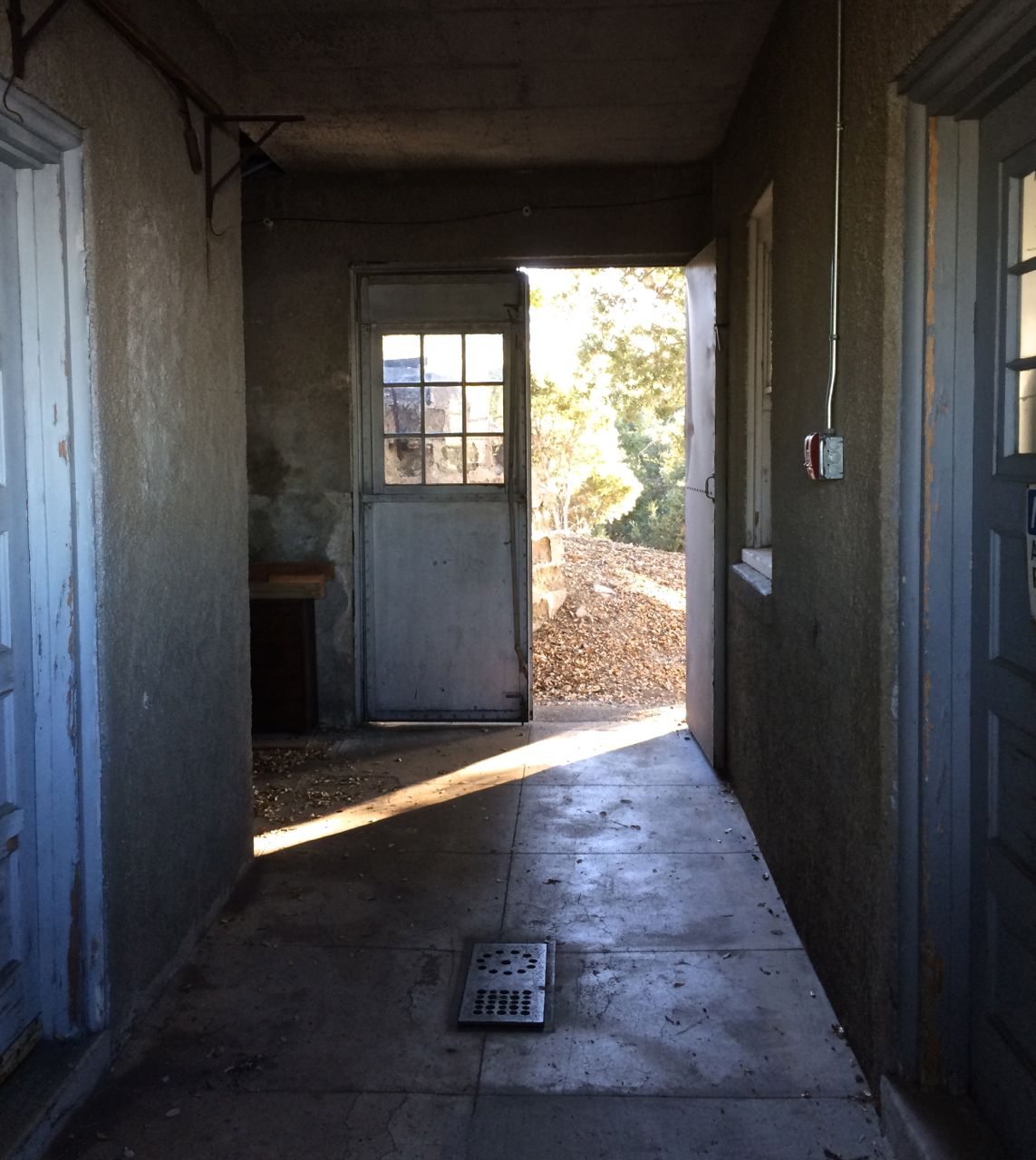
This walkway between an office and the machine room had some lovely light, so I photographed it without noticing the thing on the floor. Probably a drain. But of course I must go back and make sure.

This building houses the Snow Solar Telescope, which was the first telescope on the mountain. Hale brought it here in 1904. I've never seen it. Maybe that's because it's in use even now.

People live here. At least four cabins are occupied, as far as I know. I haven't snooped everywhere, but I can ask. I'm fascinated by the idea and I feel privileged and grateful to be here for my writing weekend.

I keep saying "my." I'm feeling ownership. I was sitting here typing when a family of tourists walked by, having ignored the "do not enter" signs and marched on into the private areas. I was immediately outraged. Then I understood their curiosity. I'm pretty sure they heeded the "DANGER: DO NOT ENTER!" signs beyond the monastery because if they hadn't they might not have come back.

I want you to have a proprietary feeling about the Mt. Wilson, too. As the Observatory ages it becomes more of a museum, and this amazing place will need you more and more, to be its protectors, visitors and benefactors.

Come on up. It's open 10am-5pm, 7 days a week, as long as the roads are open. And it'll take you longer to drive from Pasadena to Santa Monica than it'll take you to get here from just about anywhere.

I promised pictures of the monastery. I haven't forgotten.


Tuesday, September 22, 2015

Carnegie Observatories, III

Today we know this as the Andromeda galaxy, or M31. But it was known as the Andromeda nebula when this negative was taken. Edwin Hubble crossed out the "n" (which meant nova) and wrote "VAR!" in bright red, indicating he had found a variable star in the Andromeda nebula. "That first discovery of a variable star meant he could measure distance to Andromeda and show that it was in fact very, very far away and not part of our Milky Way at all," says Dr. Cindy Hunt, Caltech PhD and head of Social Media for the Carnegie Observatories. This unique plate shows Hubble's search for more variable stars in Andromeda, and you can even see "V4!!!" in Hubble's handwriting.

Even though we visited the one building in Pasadena (designed by Myron Hunt), The Carnegie Observatories is plural because it's several different observatories supported by private donations and endowments. For the last couple of posts we've been talking about the Carnegie Observatories' archive of glass plates: "astrophoto" negatives of space taken in the latter 19th and early 20th centuries.

Halley's comet, 1910.

I love the wooden boxes. Each is unique. But Dr. Hunt knows where everything is.

Not a great photo, but I like it. The Moon in a hand-labeled filing cabinet continues the theme of "a hundred years of boggling the mind."

This developed negative of the moon is from 1919. Think of how brand new it all was then. It's been nearly a hundred years. Have you seen the latest images from Pluto?

Cindy shows me glass plates. We looked at the moon, the sun, comets, galaxies, you name it.
I think she likes her job.

Cindy showed us a lot, but there was one thing she couldn't show us.
The original plate, the one Edwin Hubble took when he knew he'd discovered the expansion of the universe, is not kept here. It's too valuable. What we saw was a fine replica.

You can see many of these glass plates, and other exciting space stuff old and new, at the Carnegie Observatories Open House on Sunday, October 18th 2-5 pm. Be sure to RSVP! It's a family-friendly event. Check out one of Pasadena's little secrets.

Tuesday, September 15, 2015

Carnegie Observatories, I

Here's a familiar face.

Everybody knows Albert Einstein spent a good deal of time in Pasadena in the 1930's, lecturing at Caltech, visiting JPL and Mount Wilson, and generally being a science ambassador around Los Angeles.

Here's a center of astronomy that Einstein visited but many Pasadenans don't know about: the Carnegie Observatories. I don't think there are any telescopes in the building but even if there are, in the middle of a residential neighborhood on a residential street, most of the science here is being done on computers and in brains. A huge part of their work, however, comes from Carnegie Observatories' telescopes at Las Campanas in Chile.

Lovely little library, isn't it?

That's George Ellery Hale in the painted portrait. Hale was the idea man behind so much of what are now historical observatories, including Mount Wilson Observatory. He was even instrumental in the design of Pasadena's beautiful City Hall Plaza, where one of the buildings is named for him.

In the photograph you see, among others, Edwin Hubble (the tall guy, second from left). Hubble is most known for discovering and proving the expansion of the universe. He also figured out that a lot of what had been thought to be nebulae were, in fact, galaxies. Imagine how all those galaxies boggled minds when they hadn't been considered before.

I think you can pick out Professor Einstein in the picture.

J and I were invited to visit the Observatories by Dr. Cindy Hunt, a Caltech PhD and head of Carnegie's Social Media efforts. In the next couple of posts, Dr. Hunt's going to lead us to some places the public never sees.

We'll visit deep space via the deep, dark basement of the Carnegie Observatories. Stay with us.


In the mean time, mark your calendar for Sunday, October 18th from 2-5pm for the Carnegie Observatories open house. Click on the link and give them an RSVP, s'il vous plait.

Saturday, May 30, 2015

Mt. Wilson Observatory: A Great Adventure

The grand finale of the Mt. Wilson Observatory tour is the 100-inch telescope. Here, Edwin Hubble worked to discover his theory of the expansion of the universe. Yep. Major important stuff.

Notice anything different about how the roof of this facility opens, as opposed to the roof at the 60-inch I posted about the other day? Our guide, Observatory Superintendent Craig Woods, explained that after the 60-inch was built it was discovered that this vertical opening, as opposed to the horizontal one at the 60-inch, made for a stronger structure. 

By the way, Craig has been known to climb up to the top of the roof. 
But he's no fool, he gets strapped onto a safety catch.

The 100-inch (that refers to the diameter of the mirror) is a big telescope, though there now larger ones in the world.  

John took this picture of me and Craig at the 100-inch.

He also took a couple of great panoramas of the inside of the telescope housing. Click on these to enlarge. 
They're pretty cool.

This one really shows how big the space is. Craig and I are over on the left. We're looking into a hole in the floor. It's a sort of trap door big enough for a giant to keep his lunchbox in. The Observatory is keeping the top part of the 100-inch telescope there.

The two telescope-looking things here really are scoping devices for the 100-inch. And there are buttons. And stuff. I was just trying to explain Steampunk to Craig when we came upon this.  

I think if any one thing can convey Mt. Wilson's past, present and future importance it's this building, this telescope. Hubble's discovery was seminal. He made it here, sitting on a bentwood chair, measuring the movements he saw in the skies. There may be more powerful telescopes in the world now, but even those still observe what he discovered here.

We met Larry S. Webster, the Site Manager for CHARA, the Center for high Angular Resolution Astronomy, a project of Georgia State University. Larry has been with Mt. Wilson for 37 years. He lives there, with his wife and daughter. (What a childhood! That kid is on a first name basis with every squirrel on the mountain.) Larry told amazing stories about a building in Pasadena that was once part of the Carnegie Observatories. Just before the building was to be torn down, with all the old records in it, Larry went in with a flashlight (because the electricity had already been turned off) and rescued everything he could fit on his truck. He couldn't get it all and some things were lost. But many precious papers, records, and items are now preserved, thanks to him. I hope these will one day be part of a Mount Wilson Museum and archive here on the mountain.

There's a board of directors. They are thinking of ways to keep the place alive. Let's listen for the call and take part when it comes.

For now, join the Friends of Mount Wilson Observatory. Take a day to go on up there. It's a vigorous hike, or a leisurely drive. Have a hot dog, chili, or pie at the Cosmic Cafe. 

 And enjoy your discoveries.


Wednesday, May 13, 2015

Mount Wilson: Science in Transition

The Mount Wilson Observatory was founded in 1904 by George Ellery Hale, who encouraged the likes of Edwin Hubble and who also had a great deal to do with the way Pasadena looks today. Think the city center plaza and City Hall. Think Caltech. Thank you, Mr. Hale.

More than 100 years later, important astronomical research continues at Mount Wilson, especially the CHARA Array, operated by Georgia State University. Don't ask me what it does. I've had it explained to me twice, once by John and once by Craig Woods, and I still don't get it. But it looks cool from above.

Craig Woods, by the way, is the reason John and I got a behind-the-scenes tour. He's our friend and the superintendent at Mount Wilson, the guy with all the keys. He's up on all the experiments, the history, and the equipment at Mount Wilson. Plus he's willing to climb some precarious ladders.

I hope you'll take another look at my May 10th post about Mount Wilson. Here's a further explanation of those photos:

First, that big engine, and its rheostat, power the tool-making shed. 110 years ago, when you got up to Mount Wilson with your mule cart or your Model-T, you weren't about to run down to Flintridge if you forgot your screwdriver. If you needed a tool or a part, you made it. Many of those magnificent old things are still there. Some explain themselves, some don't. Unless you're Craig, then you know what they are.

Near the tool shed is another shed that's a treasure trove of maps, blueprints and files. There's a small library with early Scientific American magazines and other works. There's an ancient and dusty stand-up grand piano and a pool table that hasn't been used in, I would guess, 20 years.

Off the upper left of this map is the 100 inch telescope. You can see the circles indicating the 60" telescope and the smaller but taller Solar Telescope, which is still in use. The 60" has lately been used for a couple of Hollywood parties. Stars, stargazing. This is an old map so it doesn't show all the buildings you might be familiar with if you've toured Mount Wilson in recent years. Off the pathways to the right, beyond the "no entry" signs, there are some cabins that are not currently in use. Fixer-uppers.

Mount Wilson Observatory is old. Newer, larger telescopes dot the planet. The larger the telescope, the deeper into space an astronomer can study. Although Mount Wilson still has many uses, it's now in a transition phase, becoming a museum. Funding will be needed to preserve all those beautiful blueprints and plans, to maintain those telescopes and historic buildings, to keep it all available so the public can visit and learn about the early days of astronomy.

It's also a place of natural beauty, everywhere you turn, even on the steps climbing up the hillside to the tool shed.

More soon.

Saturday, August 6, 2011

Mt. Wilson Week: Hubble and Beyond

Let's top off Mt. Wilson Week with a cool building on a hot day: the 100 inch telescope.

The knowledge that there are galaxies other than our own is relatively new. It was discovered by Edwin Hubble who worked right here in this building. You can go inside, see his bentwood chair and cool off while you contemplate the universe.

This building's innards are sealed up museum-style, but did you know you can book an observing session with the 60-inch telescope at Mt. Wilson? You were looking for an interesting gift. You needed an inspiring date location. There you go. You're welcome.

If that's a little steep for you, you can become a Friend of Mt. Wilson. Even handsome, famous, old observatories need friends.

Friday, August 5, 2011

Mt. Wilson Week: Solar Telescope

I haven't described the Mt. Wilson Observatory landscape to you.

On a mountain top, wooded paths lead you amid the pines, and occasionally there looms a tower like something from a 1950's "Mars attacks" movie. You're not scared because it's sunny out, everything's in color and you can see the paint is peeling on the props.

If I have my notes right (I might not, this is why I'm not an astronomer)*, this is the 1904 Snow solar, the first telescope built at Mt. Wilson. I believe it still works. Mt. Wilson is an important, fully operational observatory even now, 107 years after its founding. So much so that when the Station Fire singed the crackly edges of its environs in 2009, many firefighters risked their lives to save it.

*I've gotten a note from Bellis, who knows: this is not the 1904 Snow telescope but the 1912, 150-foot solar tower/telescope. It's all for the best that I didn't pursue a career in astronomy--you may not believe this but I did once consider it.

From inside the dome at the top of this tower, the Mt. Wilson live towercam brings news and joy to the lowlanders. If you check out the towercam during the day (and you're not reading this twenty years from now) you'll detect green mountains in the foreground and brown ones not far in the distance, showing you some of the 250 square miles of Station Fire burn from 2009. There's some green on those hills, but they've got years 'til full recovery.

The Mt. Wilson website's history page is temptation to keep reading. George Ellery Hale founded Mt. Wilson. Edwin Hubble made historical discoveries there. Albert Einstein paid a visit. Talk about stars.