I kept getting up from my dinner last night to photograph the sunset. I finally had to stop because I was hungry. My kitchen window at my Mt. Wilson hideout looks out over Pasadena and Altadena, to the west of where I sit.
I'm fortunate to have a weekend getaway in a cabin at Mt. Wilson Observatory, high above Pasadena in the San Gabriel Mountains. Mt. Wilson was founded in 1904 by George Ellery Hale. Einstein visited here. Here, at the 100-inch telescope, Edwin Hubble discovered and proved the expansion of the universe.
While I thought of the great scientists, the moon rose almost full to shine over the places they'd walked. The valley to the west and south twinkled. The Observatory still houses scientists and experiments, but larger telescopes in Chile and Hawaii are used for the Hubble-type discoveries these days. We have too much light pollution here now.
Night critters began to make their moves. The windows and doors have screens and a breeze flows through, so I've got air conditioning without bugs. Depending on what time of year you come up, you might want a bug net that goes over your hat. I'm told the nets are $4 at Big 5. I'll have to get one for next time. The (seasonal) gnats adore me and escort my face wherever I go. Except in my cabin. They haven't figured that out yet. It's a good strategy for staying inside and writing.
It's been a long time since I've watched the sun rise. Today is the first time I've ever watched it from up on the mountain. After I had my coffee I took a walk to get some exercise, snoop and take pictures. I will never run out of Mt. Wilson pictures to post.
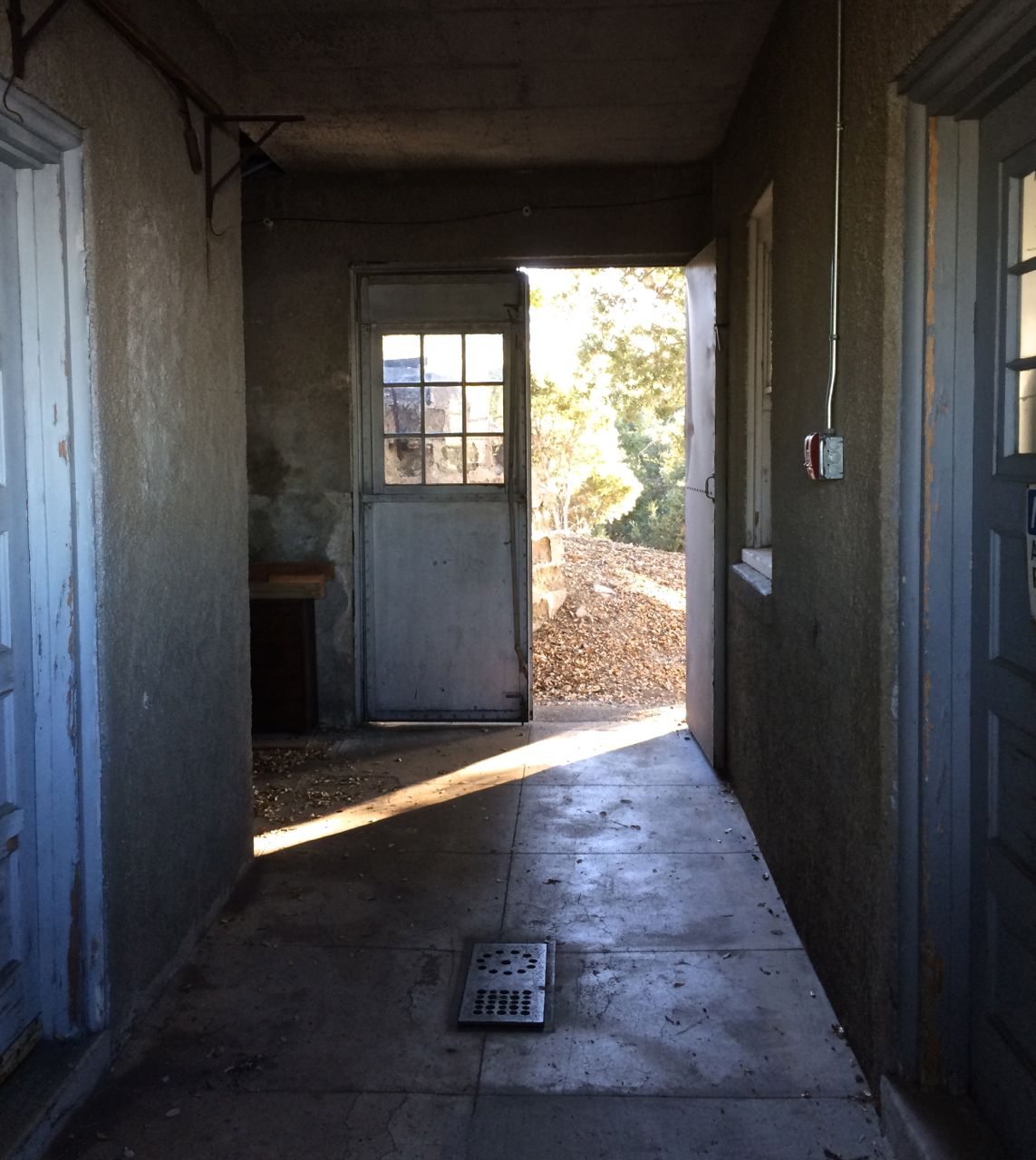
This walkway between an office and the machine room had some lovely light, so I photographed it without noticing the thing on the floor. Probably a drain. But of course I must go back and make sure.
This building houses the Snow Solar Telescope, which was the first telescope on the mountain. Hale brought it here in 1904. I've never seen it. Maybe that's because it's in use even now.
People live here. At least four cabins are occupied, as far as I know. I haven't snooped everywhere, but I can ask. I'm fascinated by the idea and I feel privileged and grateful to be here for my writing weekend.
I keep saying "my." I'm feeling ownership. I was sitting here typing when a family of tourists walked by, having ignored the "do not enter" signs and marched on into the private areas. I was immediately outraged. Then I understood their curiosity. I'm pretty sure they heeded the "DANGER: DO NOT ENTER!" signs beyond the monastery because if they hadn't they might not have come back.
I want you to have a proprietary feeling about the Mt. Wilson, too. As the Observatory ages it becomes more of a museum, and this amazing place will need you more and more, to be its protectors, visitors and benefactors.
Come on up. It's open 10am-5pm, 7 days a week, as long as the roads are open. And it'll take you longer to drive from Pasadena to Santa Monica than it'll take you to get here from just about anywhere.
I promised pictures of the monastery. I haven't forgotten.
Showing posts with label Albert Einstein. Show all posts
Saturday, September 26, 2015
Tuesday, September 15, 2015
Carnegie Observatories, I
Here's a familiar face.
Everybody knows Albert Einstein spent a good deal of time in Pasadena in the 1930's, lecturing at Caltech, visiting JPL and Mount Wilson, and generally being a science ambassador around Los Angeles.
Here's a center of astronomy that Einstein visited but many Pasadenans don't know about: the Carnegie Observatories. I don't think there are any telescopes in the building but even if there are, in the middle of a residential neighborhood on a residential street, most of the science here is being done on computers and in brains. A huge part of their work, however, comes from Carnegie Observatories' telescopes at Las Campanas in Chile.
Lovely little library, isn't it?
That's George Ellery Hale in the painted portrait. Hale was the idea man behind so much of what are now historical observatories, including Mount Wilson Observatory. He was even instrumental in the design of Pasadena's beautiful City Hall Plaza, where one of the buildings is named for him.
In the photograph you see, among others, Edwin Hubble (the tall guy, second from left). Hubble is most known for discovering and proving the expansion of the universe. He also figured out that a lot of what had been thought to be nebulae were, in fact, galaxies. Imagine how all those galaxies boggled minds when they hadn't been considered before.
I think you can pick out Professor Einstein in the picture.
J and I were invited to visit the Observatories by Dr. Cindy Hunt, a Caltech PhD and head of Carnegie's Social Media efforts. In the next couple of posts, Dr. Hunt's going to lead us to some places the public never sees.
We'll visit deep space via the deep, dark basement of the Carnegie Observatories. Stay with us.
Everybody knows Albert Einstein spent a good deal of time in Pasadena in the 1930's, lecturing at Caltech, visiting JPL and Mount Wilson, and generally being a science ambassador around Los Angeles.
Here's a center of astronomy that Einstein visited but many Pasadenans don't know about: the Carnegie Observatories. I don't think there are any telescopes in the building but even if there are, in the middle of a residential neighborhood on a residential street, most of the science here is being done on computers and in brains. A huge part of their work, however, comes from Carnegie Observatories' telescopes at Las Campanas in Chile.
Lovely little library, isn't it?
That's George Ellery Hale in the painted portrait. Hale was the idea man behind so much of what are now historical observatories, including Mount Wilson Observatory. He was even instrumental in the design of Pasadena's beautiful City Hall Plaza, where one of the buildings is named for him.
In the photograph you see, among others, Edwin Hubble (the tall guy, second from left). Hubble is most known for discovering and proving the expansion of the universe. He also figured out that a lot of what had been thought to be nebulae were, in fact, galaxies. Imagine how all those galaxies boggled minds when they hadn't been considered before.
I think you can pick out Professor Einstein in the picture.
J and I were invited to visit the Observatories by Dr. Cindy Hunt, a Caltech PhD and head of Carnegie's Social Media efforts. In the next couple of posts, Dr. Hunt's going to lead us to some places the public never sees.
We'll visit deep space via the deep, dark basement of the Carnegie Observatories. Stay with us.
In the mean time, mark your calendar for Sunday, October 18th from 2-5pm for the Carnegie Observatories open house. Click on the link and give them an RSVP, s'il vous plait.
Thursday, May 10, 2012
A Brilliant Idea
The Dena Magazine has got something going on. These guys started small and kept going, bridging gaps, and they
haven't stopped. Sometimes they write about things other Pasadena publications
either gloss over or never mention at all. I think their progress is well worth watching.
On May 19th, from 10am-3pm, The Dena Magazine brings us The Dena Community Business and Arts Expo at the Pasadena Senior Center, 85 E. Holly Street. I have no idea what it'll be like but my guess tells me it will be diverse and interesting, with young businesses and new faces. When we attend at the Convention Center ten years from now we can say we were at the first one.
"Einstein and Beyond," the 1998 mural on the south side of the Senior Center, is by southern California artist Gifford Myers. The mural is part of Pasadena Public Art Walking Tour #3.
On May 19th, from 10am-3pm, The Dena Magazine brings us The Dena Community Business and Arts Expo at the Pasadena Senior Center, 85 E. Holly Street. I have no idea what it'll be like but my guess tells me it will be diverse and interesting, with young businesses and new faces. When we attend at the Convention Center ten years from now we can say we were at the first one.
"Einstein and Beyond," the 1998 mural on the south side of the Senior Center, is by southern California artist Gifford Myers. The mural is part of Pasadena Public Art Walking Tour #3.
Friday, August 5, 2011
Mt. Wilson Week: Solar Telescope
I haven't described the Mt. Wilson Observatory landscape to you.
On a mountain top, wooded paths lead you amid the pines, and occasionally there looms a tower like something from a 1950's "Mars attacks" movie. You're not scared because it's sunny out, everything's in color and you can see the paint is peeling on the props.
If I have my notes right (I might not, this is why I'm not an astronomer)*, this is the 1904 Snow solar, the first telescope built at Mt. Wilson. I believe it still works. Mt. Wilson is an important, fully operational observatory even now, 107 years after its founding. So much so that when the Station Fire singed the crackly edges of its environs in 2009, many firefighters risked their lives to save it.
*I've gotten a note from Bellis, who knows: this is not the 1904 Snow telescope but the 1912, 150-foot solar tower/telescope. It's all for the best that I didn't pursue a career in astronomy--you may not believe this but I did once consider it.
From inside the dome at the top of this tower, the Mt. Wilson live towercam brings news and joy to the lowlanders. If you check out the towercam during the day (and you're not reading this twenty years from now) you'll detect green mountains in the foreground and brown ones not far in the distance, showing you some of the 250 square miles of Station Fire burn from 2009. There's some green on those hills, but they've got years 'til full recovery.
The Mt. Wilson website's history page is temptation to keep reading. George Ellery Hale founded Mt. Wilson. Edwin Hubble made historical discoveries there. Albert Einstein paid a visit. Talk about stars.
On a mountain top, wooded paths lead you amid the pines, and occasionally there looms a tower like something from a 1950's "Mars attacks" movie. You're not scared because it's sunny out, everything's in color and you can see the paint is peeling on the props.
If I have my notes right (I might not, this is why I'm not an astronomer)*, this is the 1904 Snow solar, the first telescope built at Mt. Wilson. I believe it still works. Mt. Wilson is an important, fully operational observatory even now, 107 years after its founding. So much so that when the Station Fire singed the crackly edges of its environs in 2009, many firefighters risked their lives to save it.
*I've gotten a note from Bellis, who knows: this is not the 1904 Snow telescope but the 1912, 150-foot solar tower/telescope. It's all for the best that I didn't pursue a career in astronomy--you may not believe this but I did once consider it.
From inside the dome at the top of this tower, the Mt. Wilson live towercam brings news and joy to the lowlanders. If you check out the towercam during the day (and you're not reading this twenty years from now) you'll detect green mountains in the foreground and brown ones not far in the distance, showing you some of the 250 square miles of Station Fire burn from 2009. There's some green on those hills, but they've got years 'til full recovery.
The Mt. Wilson website's history page is temptation to keep reading. George Ellery Hale founded Mt. Wilson. Edwin Hubble made historical discoveries there. Albert Einstein paid a visit. Talk about stars.
Subscribe to:
Posts (Atom)